

A Small Office for His Work
Back in Kirtland, many of the elders felt they had been strengthened by their journey. They had spent a good deal of time outdoors and had been physically challenged. Additionally, their faith had been tested, and they came out stronger. Not so for Ezra Booth. For him it was a total collapse of faith. He recalled his disappointment in the quality of the land in Independence and the long and difficult journey home. Also, it irked him that after their canoes had turned over, he was required to walk the rest of the way to Kirtland while Joseph, Sidney, and Oliver had the luxury of traveling by stage.
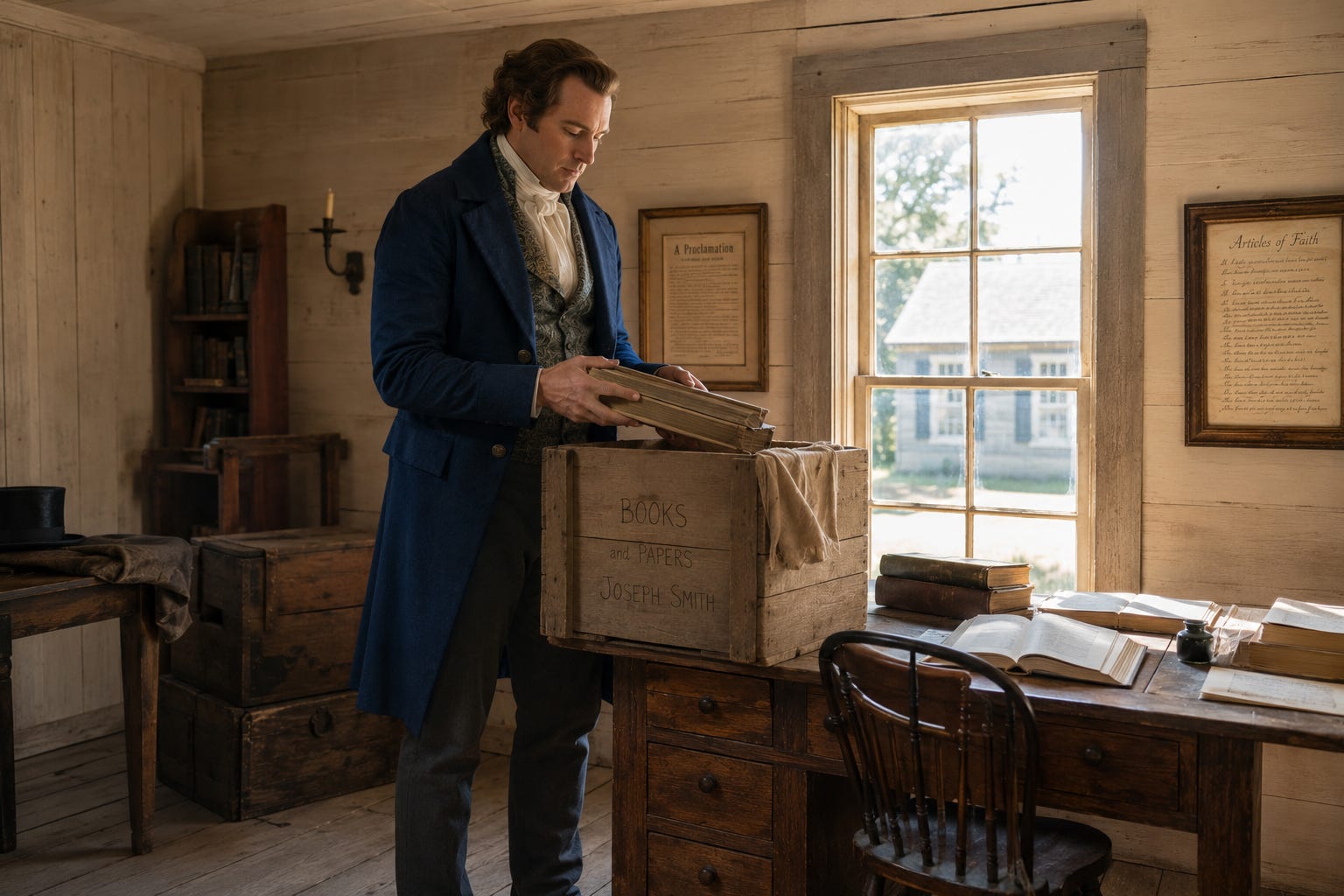
Joseph and Emma settled in a spacious room in the home of John Johnson located on the outskirts of Hiram, a short distance from the Kirtland Saints. Here Joseph would have a small office for his work. He busied himself unpacking books and sorting through his possessions when he noticed the creak of the small cabin door. He went to see the cause of the sound and found Ezra Booth standing at the open entryway, his face showing tight muscles and sharp lines; clearly angry.
“I understand that you didn’t even bother to preach in Cincinnati as you were commanded. It appears even you don’t take the revelations seriously.”
“I’m not sure I like your tone,” Joseph’s eyes followed Ezra as he began to pace.
“I don’t give a damn! I’ve long had problems with your tone. Hardly proper for a servant of the Lord to go around with such a jovial spirit and jesting as you do!”
“One needn’t always be so serious, Brother Ezra. Tell me, what really brings you here? Do you have a problem with one of the revelations?”
“With several!” the errant elder snapped. “Like the revelation you had in Zion. Do you really think after He told you to go speedily by craft, a just God would then say, ‘I was mad at you yesterday, so I cursed the waters?’” Ezra shook his head incredulously.
“Are you implying God is not just?”
“The justice of God is not the issue here. It is this magic charm of delusion and falsehood that you spin.”
Joseph pushed himself away from his desk and demanded: “Retract that statement.”
“I cannot. I was swayed by your magic spell, but the spell has been broken.”
“There is no spell. You are in a state of apostasy.”
“Call it what you will. Someday you’ll be sorry we ever met.” Ezra turned and walked out the door.
Joseph walked softly towards the door and closed it. He sat again and pondered his conversation with Brother Ezra. He had been aware of his contentious spirit during their travels, but he had to remain focused on the problems of the present. Whether the man fulfilled any of his threats or quietly returned to the fold was not under his control.
Joseph received another revelation that the land of Zion was to be purchased. Newel K. Whitney was to impart all that he could. Others were also named as contributors.
It was September and the air was much cooler. The Johnson spread included a large two-story frame house, two large barns, and several outbuildings. Sidney would stay in Hiram and travel to see his family as often as practical.
Joseph and Sidney were diligent in their work of editing the Bible. Throughout the book of Genesis, they corrected what Joseph called small errors and changes that had taken place over centuries of careless copying. Toward the end of the book the spirit poured forth and Joseph was moved to add many words, including a prophecy of the coming forth of the new and everlasting gospel.
The weeks passed quickly, and the mild fall climate began to turn crisp. On one mid-October day, Sidney began to prepare for work but seemed to be heavy with thought.”
“What is it?” Joseph asked.
“I was thinking about the news of the day. Have you seen the latest issues of the Ohio Star?”
“No, but I hear Ezra has been writing unkind things about us.”
“It goes further than that. He says this is nothing more than a deeply laid plan of craft and deception.”
“By this, I assume you mean the gospel.”
Sidney nodded, “Of course.”
“That has been his complaint all along. How can he so quickly forget? He was an eyewitness to Sister Johnson’s cure.”
“I’m not sure he considers the incident. He was disappointed, as we all were, in the quality of land in Zion. It strikes me that he was suspicious and watchful from the start. Our journey home didn’t help strengthen his faith.”
“You’re probably right,” Joseph agreed.
Sidney broke into a brief silence. “Are we going to let him continue his lies?”
Joseph looked Rigdon straight in the eye: “Why don’t you challenge him? A man of your eloquence should be able to shoot holes through this man’s venom.”
Sidney smiled as his mind began to conceive an upcoming debate.
The two men returned to the translation work. When they came to the thirteenth chapter of Isaiah, they found an important prophecy of the coming forth of the Book of Mormon had been omitted. Joseph dictated the missing words.
Sidney said, “Now that we have all the words, we can see it was a prophecy–a prophecy that has been fulfilled in our time.” Sidney gasped. “For so many years when reading that passage, I was misled.”
Joseph’s work could never be limited to the translation. He attended meetings and assisted in making arrangements for the purchase of the printing press. The press was to be taken to Zion where the church would begin the publication of a monthly newsletter, the Evening and the Morning Star. Baptisms were performed, and the church continued to grow, both in Kirtland and in the land of Zion.
Toward the end of October, an important conference was held in Orange County, Ohio where a branch of sixty thrived. At this conference, a special revelation was received for William McLellin. He was called to leave his home and travel in the nearby regions proclaiming the gospel. Seventeen additional high priests were ordained under the hands of Oliver Cowdery.
The Book of Commandments
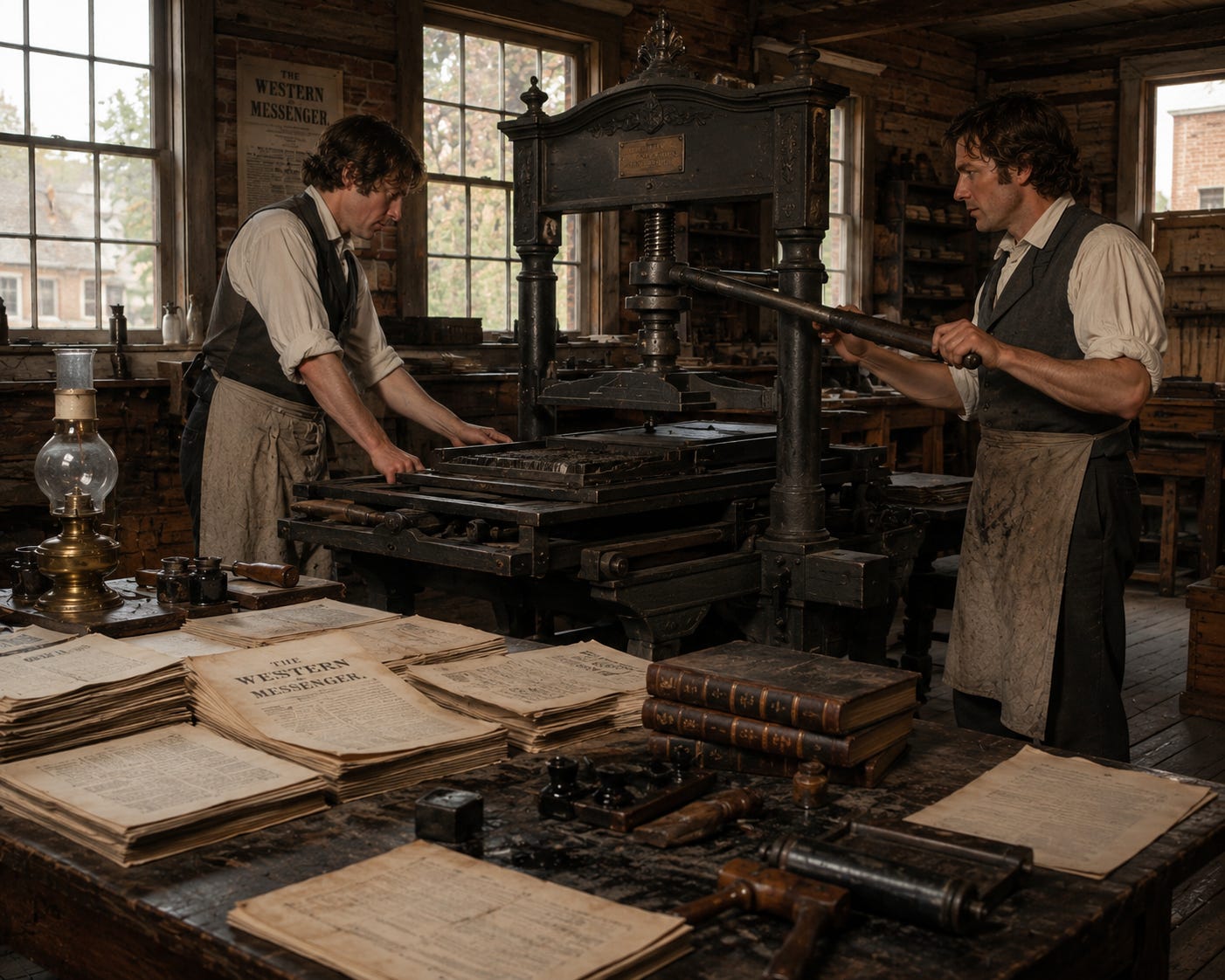
There were four conferences held during the beginning of November. It was decided that ten thousand copies of the Book of Commandments, the chosen title of the book of revelations, should be printed for publication and for the use of membership of the church. A preface was revealed by the spirit, and a testimony to the truth of the revelations was written and signed by all present.
By November 15, the revelations had been copied and checked for accuracy, dedicated by prayer to the service of Almighty God, and then sealed and given to Oliver, who, for safety’s sake, would be accompanied by John Whitmer on his journey to Zion.
Ezra Booth’s animosity was becoming public knowledge. His weekly letters published in the Ohio Star were causing many to become weak in the faith. He had publicized the organization of Zion and the high priesthood. He spoke of the past acting out by Leman Copley and others as though it were supported by the church. He gave his version of how Joseph received revelations and challenged Joseph’s right to revise the existing Bible. In his latest letter, he exposed many details of the First General Conference in Kirtland and the journey to and from Zion.
Joseph took Booth’s articles in stride, but when Ezra quoted from the revealed word of the Lord, making the revelations public, he bristled.
Booth’s articles had upset others as well. Joseph began to sense a feeling of animosity from the Saints in Kirtland and the small community in Hiram. Worse still, this same animosity was expressed by some of the Johnson family. John Johnson and his wife remained firm in the faith.
“I saw you with my sister,” Eli Johnson accused.
Joseph nodded slightly. “Yes. I was talking with her.”
“I also saw the w-a-y you looked at her.” Eli dragged the word ‘way’ for effect.
That evening, tensions in the Johnson household ran high until the word of the Lord came again: “Proclaim unto the world in the regions round about for the space of a season.”
Joseph and Sidney were to leave Hiram and diffuse the tensions. The first stop they made was in Kirtland where further direction was given on the organization of the church. Newel K. Whitney was named bishop and it would be his responsibility to keep the Lord’s storehouse. The revelation was sensitive to the fact that many in the Kirtland community had nothing to give. Their needs were to be met by the storehouse of Zion.
Joseph and Sidney remained in Kirtland for only a short time. They remained on the move, stopping at small communities and dispelling the rumors set into motion by Booth’s scandalous letters.
Waiting for Ezra Booth
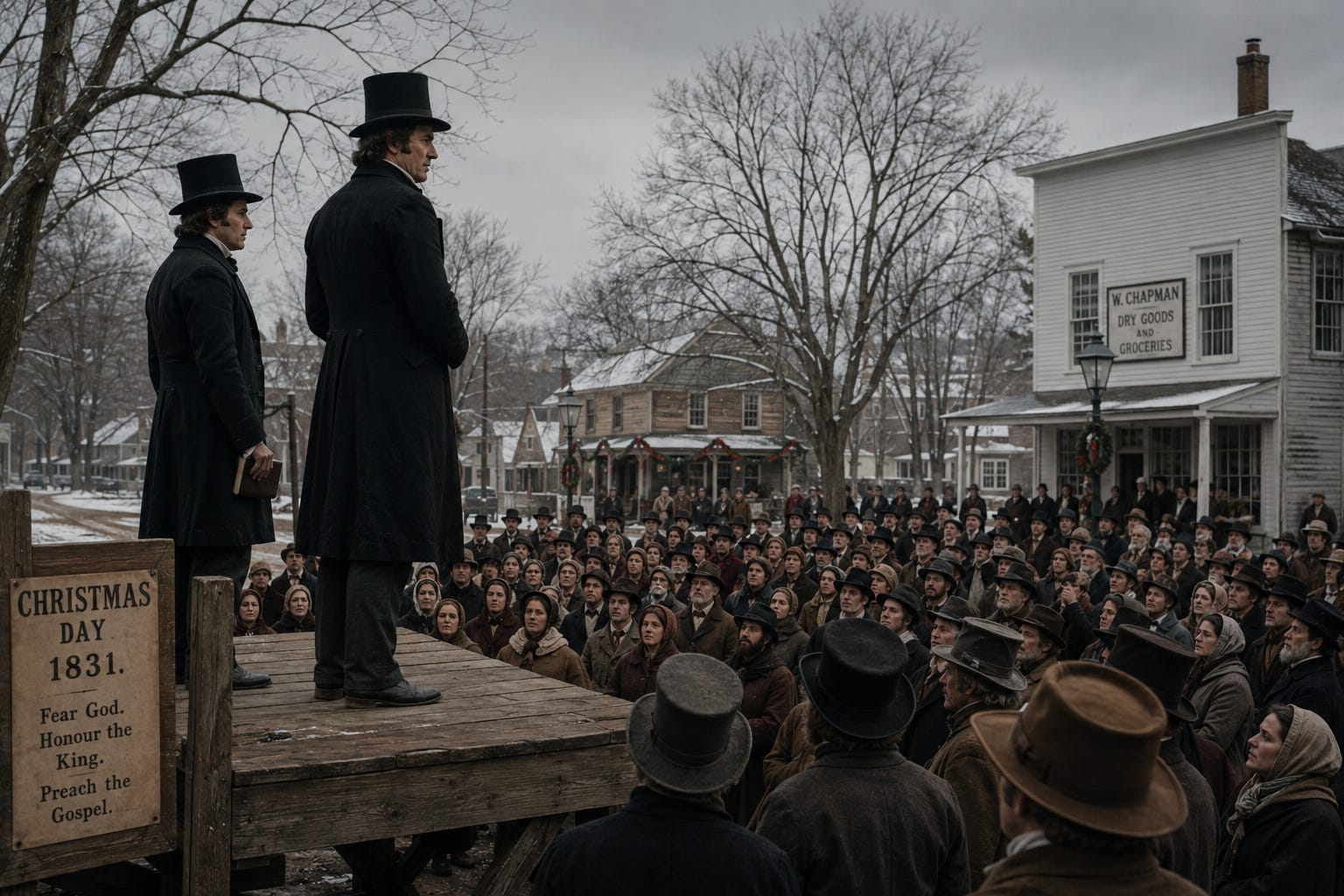
On Christmas day, the day scheduled for Sidney’s public debate with Ezra, Joseph awoke early and eagerly. He and Sidney ate a small breakfast and saddled their horses for the ride to Ravenna where the debate was scheduled to take place. There was a large crowd eager to come to some conclusion as to the things they had heard, but Ezra did not show up for the debate.
Sidney stood tall before his listeners. “He dare not appear because he knows his letters are false and will not bear the test of investigation.” With that, the matter was dropped.
Joseph and Sidney returned to Hiram and the Johnsons’ farm. Here, by the word of the Lord, they resumed their work on the translation. After two weeks, they took a short break. When they returned, they began to work on the gospel of John. They considered the possibility that many important points touching the salvation of man could have been lost from John’s gospel as well.
They began to work on the gospel as it was now given through inspiration. They found new insights on the resurrection of the just and the unjust that caused them to wonder anew. “If, as Paul tells us in Corinthians, God rewards every man according to the deeds done in the body, then heav–”
Sidney completed the thought. “Heaven may be different from what we have thought it to be.”
“Yes. I fear that may be so.”
That evening, among a small group of elders, Joseph and Sidney recounted how they had prayed and a vision was opened before their eyes. They now had a new understanding of heaven and hell. The gospel was not so black and white as commonly taught by sectarian priests, and hell was a place reserved only for those who deny the Holy Spirit after having received it. These poor souls would go into eternal, but not everlasting, punishment, for as God is eternal, so is His punishment eternal. As the moon differs from the sun and the stars, so there are differences in the three kingdoms of heaven.
Joseph and Sidney both explained their new wisdom: The Terrestrial Kingdom has been reserved for men who are just, those who never hear the gospel while in the flesh but receive it while in the spirit. Those who were blinded by the craftiness of men and those who were not valiant in their testimony of Jesus, will receive a presence of the Son, but not the fullness of the Father.
The Telestial Kingdom has been reserved for those who neither accept the gospel of Christ nor the testimony of Jesus, but who do not deny the Holy Spirit. They will be thrust down to hell until the last resurrection, when they will be judged for their works in the flesh and become servants of the Most High.
The Celestial Kingdom has been reserved for those who have received the fullness of His grace. These will dwell in his presence.
Much of the vision was great and marvelous beyond human understanding; they were commanded not to write for fear that man was not capable of knowing such things without the power of the spirit. This spirit had been bestowed upon Sidney Rigdon and Joseph Smith.
* * * The End * * *
I hope you enjoyed: Apostasy
NOTE: Join us next week for another exciting ‘Holy Joe!’ frontier tale:
Tar and Feathering
Feel free to drop a comment below—I read and respond to every single one. Don’t forget to like and subscribe so you don’t miss the next chapter!
Thank you.
Just Judy, author
A Note re: Images:
Not all the images in this post have been created by Gemini.ai. It’s brilliant, but much like you and I, not without flaws. I am also exploring ChatGPT’s ability to provide images, and leonardo.ai. Out of the three images provided I select which I think is best. I hope to one day have my character descriptions so tuned-in that Joseph will always look like the Joseph of the previous chapters. This will be a new skill for me, but I know readers will be patient. Still, they tell me it shouldn’t take too long to learn this new skill.
Feel free to drop a comment on any post that catches your eye. I promise to read every word. Like and subscribe. It’s free. Don’t miss out on future posts.
* * * * *
What really caught my attention was Ezra Booth’s transition from belief to opposition. Instead of describing his change as a sudden, dramatic shift, it’s shown as a gradual process. Disappointment slowly builds through the difficult journey, unmet expectations about Zion, frustration over how the return trip was handled, and growing theological doubts. In time, experiences he once saw through faith now seem entirely different to him.
This is so relatable. Sometimes, the facts of our past stay the same, but the way we interpret them shifts. What once supported our beliefs can, later on, serve as evidence against them—especially depending on where we’re coming from when we look back.
I also found the contrast with Joseph and Sidney very interesting. While Booth openly challenges Joseph’s revelations and questions his authority, Joseph and Sidney are quietly wrestling with scripture themselves. They revisit familiar passages, ask whether traditional interpretations are complete, and discover ideas that deepen their understanding of heaven and judgment. Belief in this chapter feels alive and evolving. Everyone is interpreting, questioning, defending, changing, and deciding what they can still accept, making it a vibrant journey of faith.
Ezra comes across as a more compelling character than just a simple antagonist. His criticism carries weight and can even feel quite personal and hostile at times, yet we also get a glimpse of the disappointment and reasoning that led him there. Similarly, Joseph isn't just standing firm on the other side; he's navigating criticism, tensions within the community, the responsibilities of a growing church, and his ongoing theological journey.
That sense of tension really brings the history to life. These aren’t people who already know how everything will turn out. They live in uncertainty, interpret events as they happen, and make choices that will shape much bigger stories later on.
Keep emphasizing those very human aspects—disappointment, conviction, resentment, doubt, loyalty, and changing interpretations. When we see these historical figures struggle rather than just represent opposing ideas, it makes it so much easier for readers to stay engaged and connect with what those moments might have felt like as they unfolded.